
THE SUPERWIDE FORMAT PRINT SPECIALISTS



-

Printed In Our UK Warehouse
-

On-site Solar Power Energy Generation
-

Quick Production Time


-
Printed In Our UK Warehouse
-
On-site Solar Power Energy Generation
-
Quick Production Time
CATEGORIES.
WE DON’T JUST PRINT BANNERS.

OVER 50,000 square metres of digital print per week*
BLOG.
View All Posts-

The Print Show 2026
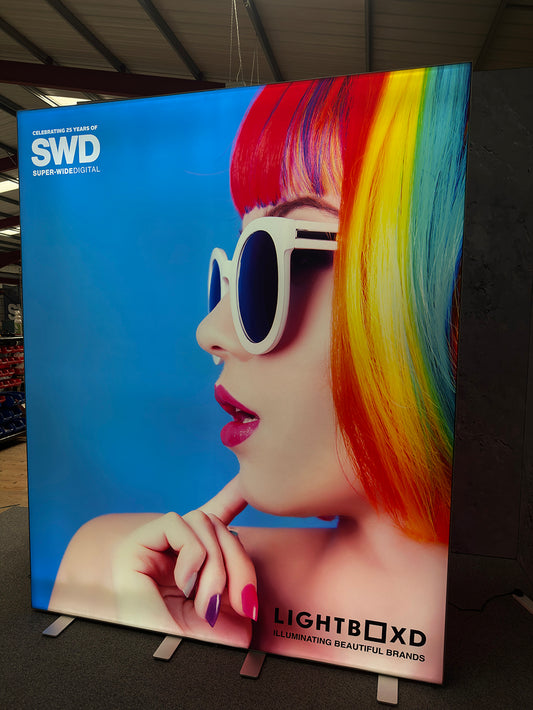
Thank you to everyone who attended The Print Show at NEC Birmingham and visited our stand. We truly appreciate your time and support. Our lightboxd products helped us stand out from the crowd!We displayed our expanded LIGHTBOXD range at the Show along with a bespoke Lightboxe frame system. If you’ve got an exhibition job coming up, it’s a good opportunity to pick up one of our LIGHTBOXD kits https://super-wide.com/collections/lightboxes At Super-Wide Digital, we pride ourselves on delivering high-quality large-format print solutions with the speed, reliability, and expertise our customers depend on. For over 25 years, we’ve worked closely with printers, agencies, exhibition companies, retailers, and creative professionals across the UK, helping bring campaigns, events, and brand spaces to life at scale. What sets us apart is our ability to handle everything in-house — from superwide printing and dye sublimation to finishing, fabrication, welding, and installation preparation. By keeping production under one roof, we maintain complete control over quality, consistency, and turnaround times. Our investment in advanced print technology allows us to produce vibrant, durable graphics across a huge range of applications, including: * Exhibition and event graphics. * Retail displays and POS. * Fabric and textile printing. * Lightboxes and backlit displays. * Outdoor banners and building wraps. * Acrylic and rigid media printing. We understand that deadlines matter. That’s why we’ve built our operation around fast, dependable production without compromising on quality. Whether you need a single specialist project or large-volume national campaign support, our experienced team is here to help. At Super-Wide Digital, we don’t just print graphics — we help our customers create a lasting impact.
The Print Show 2026
Thank you to everyone who attended The Print Show at NEC Birmingham and visited our stand. We truly appreciate your time and support. Our lightboxd products helped us stand out from the crowd!We displayed our expanded LIGHTBOXD range at the Show along with a bespoke Lightboxe frame system. If you’ve got an exhibition job coming up, it’s a good opportunity to pick up one of our LIGHTBOXD kits https://super-wide.com/collections/lightboxes At Super-Wide Digital, we pride ourselves on delivering high-quality large-format print solutions with the speed, reliability, and expertise our customers depend on. For over 25 years, we’ve worked closely with printers, agencies, exhibition companies, retailers, and creative professionals across the UK, helping bring campaigns, events, and brand spaces to life at scale. What sets us apart is our ability to handle everything in-house — from superwide printing and dye sublimation to finishing, fabrication, welding, and installation preparation. By keeping production under one roof, we maintain complete control over quality, consistency, and turnaround times. Our investment in advanced print technology allows us to produce vibrant, durable graphics across a huge range of applications, including: * Exhibition and event graphics. * Retail displays and POS. * Fabric and textile printing. * Lightboxes and backlit displays. * Outdoor banners and building wraps. * Acrylic and rigid media printing. We understand that deadlines matter. That’s why we’ve built our operation around fast, dependable production without compromising on quality. Whether you need a single specialist project or large-volume national campaign support, our experienced team is here to help. At Super-Wide Digital, we don’t just print graphics — we help our customers create a lasting impact.
Read More -

Why Illuminated Exhibition Stands Attract Up to...
Why Illuminated Exhibition Stands Attract Up to Three Times More Visitors? And what the science says about why your brain is drawn to light before anything else. You have spent months preparing for this exhibition. You have paid for your floor space, organised the team, briefed the designer, and had everything printed and packed. You arrive at the venue, set up your stand, and then look around at the competition. Some stands look just like yours. A fabric backdrop. A table. Some leaflets. And then there is the stand three aisles over that seems to be pulling every passing visitor in like a magnet. It is lit up. The graphics glow. People stop without thinking about it. This is not a coincidence, and it is not just about having a bigger budget. There is a reason illuminated displays consistently outperform non-illuminated alternatives on exhibition floors. The answer lies in how the human brain processes visual information, and it has been this way for thousands of years. The Numbers First Before we get into the science, here is what the data shows about illuminated displays at exhibitions and trade shows. 3x More foot traffic than non-illuminated stands 60% Uplift in visitor traffic with illuminated displays 40% More qualified leads reported after switching to backlit displays Sources: industry research compiled from US and UK exhibition display suppliers and exhibitor case studies. Individual results will vary. A mid-sized software company that switched from a standard fabric display to a custom backlit stand reported a 40% increase in qualified leads at their very next event. Not over a year. At the next show. The stand did not change size. The company did not spend more on floor space. They changed the way the display was lit. The Science: Why Your Brain Cannot Ignore a Lit Display Human beings are, at a fundamental biological level, wired to notice light. This is not a marketing theory. It is neuroscience. Brightness and contrast are among the earliest signals the human visual system uses to direct attention, before conscious thought kicks in at all. The process is called pre-attentive processing. Before you have consciously decided to look at something, your brain has already scanned the environment and identified high-contrast, high-brightness stimuli as priority targets. This happens in milliseconds. It is the same mechanism that makes you notice a moving object in your peripheral vision, or a bright light in a dark room. Research published in scientific literature consistently shows that luminance (the technical term for brightness) is one of the primary drivers of visual salience: the quality that makes something stand out from its surroundings. In a trade show environment filled with competing displays, all under the same flat overhead lighting, a backlit display creates immediate contrast. The graphics appear brighter, more saturated, and more vivid than their surroundings. The brain flags them as worth looking at, before the visitor has made any conscious decision to engage. Studies from the field of environmental psychology also show that humans respond emotionally to well-lit environments. Brighter light increases cognitive alertness and positive emotional response. In practical terms, this means visitors do not just notice an illuminated stand more readily. They tend to feel more engaged and receptive when they arrive at one. The Exhibition Hall Problem Understanding why this matters so much at exhibitions requires thinking about the specific environment. Exhibition halls are not like shops or offices. They are typically vast, loud, and visually overwhelming. Dozens or hundreds of stands compete for the same attention within the same space. Visitors are on their feet all day, processing a constant stream of competing visual stimuli. In this environment, most displays blend into a uniform sea of printed fabric and foam board. The overhead lighting is identical across every stand. There is no shadow or highlight to help one display stand out from the next. To a tired visitor scanning the hall for what to look at next, most stands look the same. A backlit LED lightbox changes that entirely. It introduces its own light source into the equation, one that is independent of the hall's overhead lighting. The display glows from within. The graphics are rendered at a higher apparent brightness and colour saturation than anything printed conventionally. In the visual hierarchy of the room, it sits at the top. In a hall where every stand has the same overhead lighting, the one that brings its own light wins the visual competition before anyone has taken a single step towards it. What This Means for Your Exhibition Presence The practical implication is straightforward: the decision to invest in an illuminated display is not primarily an aesthetic one. It is a strategic one. Foot traffic drives conversations. Conversations drive leads. Leads drive sales. If an illuminated stand increases the number of people who stop and engage, everything that follows improves proportionally. There are several practical advantages worth noting alongside the visibility benefit. Practical Advantages of LED Lightbox Displays Consistent brightness regardless of the hall's ambient lighting conditions. Higher colour accuracy and saturation: graphics look exactly as designed, not washed out under overhead lights. Works equally well in daylight venues and darker event environments. Lightweight aluminium frames make set-up and breakdown faster than heavier alternatives. Tool-free assembly means your team can handle set-up without specialist help on the day. Fabric skins can be updated between events, keeping the display fresh without replacing the frame. A Final Thought The average attendee at a UK trade show spends around five and a half hours on the exhibition floor. In that time, they will walk past hundreds of stands. The stands that get remembered are the ones that stopped them in their tracks. Light is the oldest and most reliable way to do that. Your brain has been responding to it long before exhibitions existed. The best-performing stands on any exhibition floor understand this, and they use it deliberately. If your current display blends in rather than stands out, it may not be the design, the messaging, or the product that is holding you back. It may simply be that your stand is dark. See the LightBoxd Pro Range Professional LED lightbox display systems for exhibitions and events. Find your nearest approved supplier.
Why Illuminated Exhibition Stands Attract Up to...
Why Illuminated Exhibition Stands Attract Up to Three Times More Visitors? And what the science says about why your brain is drawn to light before anything else. You have spent months preparing for this exhibition. You have paid for your floor space, organised the team, briefed the designer, and had everything printed and packed. You arrive at the venue, set up your stand, and then look around at the competition. Some stands look just like yours. A fabric backdrop. A table. Some leaflets. And then there is the stand three aisles over that seems to be pulling every passing visitor in like a magnet. It is lit up. The graphics glow. People stop without thinking about it. This is not a coincidence, and it is not just about having a bigger budget. There is a reason illuminated displays consistently outperform non-illuminated alternatives on exhibition floors. The answer lies in how the human brain processes visual information, and it has been this way for thousands of years. The Numbers First Before we get into the science, here is what the data shows about illuminated displays at exhibitions and trade shows. 3x More foot traffic than non-illuminated stands 60% Uplift in visitor traffic with illuminated displays 40% More qualified leads reported after switching to backlit displays Sources: industry research compiled from US and UK exhibition display suppliers and exhibitor case studies. Individual results will vary. A mid-sized software company that switched from a standard fabric display to a custom backlit stand reported a 40% increase in qualified leads at their very next event. Not over a year. At the next show. The stand did not change size. The company did not spend more on floor space. They changed the way the display was lit. The Science: Why Your Brain Cannot Ignore a Lit Display Human beings are, at a fundamental biological level, wired to notice light. This is not a marketing theory. It is neuroscience. Brightness and contrast are among the earliest signals the human visual system uses to direct attention, before conscious thought kicks in at all. The process is called pre-attentive processing. Before you have consciously decided to look at something, your brain has already scanned the environment and identified high-contrast, high-brightness stimuli as priority targets. This happens in milliseconds. It is the same mechanism that makes you notice a moving object in your peripheral vision, or a bright light in a dark room. Research published in scientific literature consistently shows that luminance (the technical term for brightness) is one of the primary drivers of visual salience: the quality that makes something stand out from its surroundings. In a trade show environment filled with competing displays, all under the same flat overhead lighting, a backlit display creates immediate contrast. The graphics appear brighter, more saturated, and more vivid than their surroundings. The brain flags them as worth looking at, before the visitor has made any conscious decision to engage. Studies from the field of environmental psychology also show that humans respond emotionally to well-lit environments. Brighter light increases cognitive alertness and positive emotional response. In practical terms, this means visitors do not just notice an illuminated stand more readily. They tend to feel more engaged and receptive when they arrive at one. The Exhibition Hall Problem Understanding why this matters so much at exhibitions requires thinking about the specific environment. Exhibition halls are not like shops or offices. They are typically vast, loud, and visually overwhelming. Dozens or hundreds of stands compete for the same attention within the same space. Visitors are on their feet all day, processing a constant stream of competing visual stimuli. In this environment, most displays blend into a uniform sea of printed fabric and foam board. The overhead lighting is identical across every stand. There is no shadow or highlight to help one display stand out from the next. To a tired visitor scanning the hall for what to look at next, most stands look the same. A backlit LED lightbox changes that entirely. It introduces its own light source into the equation, one that is independent of the hall's overhead lighting. The display glows from within. The graphics are rendered at a higher apparent brightness and colour saturation than anything printed conventionally. In the visual hierarchy of the room, it sits at the top. In a hall where every stand has the same overhead lighting, the one that brings its own light wins the visual competition before anyone has taken a single step towards it. What This Means for Your Exhibition Presence The practical implication is straightforward: the decision to invest in an illuminated display is not primarily an aesthetic one. It is a strategic one. Foot traffic drives conversations. Conversations drive leads. Leads drive sales. If an illuminated stand increases the number of people who stop and engage, everything that follows improves proportionally. There are several practical advantages worth noting alongside the visibility benefit. Practical Advantages of LED Lightbox Displays Consistent brightness regardless of the hall's ambient lighting conditions. Higher colour accuracy and saturation: graphics look exactly as designed, not washed out under overhead lights. Works equally well in daylight venues and darker event environments. Lightweight aluminium frames make set-up and breakdown faster than heavier alternatives. Tool-free assembly means your team can handle set-up without specialist help on the day. Fabric skins can be updated between events, keeping the display fresh without replacing the frame. A Final Thought The average attendee at a UK trade show spends around five and a half hours on the exhibition floor. In that time, they will walk past hundreds of stands. The stands that get remembered are the ones that stopped them in their tracks. Light is the oldest and most reliable way to do that. Your brain has been responding to it long before exhibitions existed. The best-performing stands on any exhibition floor understand this, and they use it deliberately. If your current display blends in rather than stands out, it may not be the design, the messaging, or the product that is holding you back. It may simply be that your stand is dark. See the LightBoxd Pro Range Professional LED lightbox display systems for exhibitions and events. Find your nearest approved supplier.
Read More

